Quantum Computer Technology: The Future of Computing
The world has witnessed several technological revolutions over the past century-from the invention of the first electronic computers to the rise of cloud computing, artificial intelligence (AI), and machine learning. Each innovation has fundamentally changed how people live, communicate, and conduct business. Today, we are entering another transformative era driven by Quantum Computer Technology.
Unlike conventional computers that process information using binary bits, quantum computers leverage the principles of quantum mechanics to perform computations in ways that were previously unimaginable. These machines are not simply faster versions of today's computers; they represent an entirely different approach to solving problems.
Researchers believe quantum computing will revolutionize medicine, cybersecurity, logistics, climate science, financial modeling, and artificial intelligence. Governments, universities, and leading technology companies are investing billions of dollars into quantum research because its potential could reshape nearly every major industry.
In this comprehensive guide, you'll learn what quantum computer technology is, how it works, its real-world applications, current challenges, and why it may become one of the defining technologies of the 21st century.
What is Quantum Computer Technology?
Quantum computer technology is an advanced field of computing that uses the laws of quantum mechanics to process information. Unlike classical computers, which represent data using binary digits (0 or 1), quantum computers use quantum bits, commonly known as qubits.
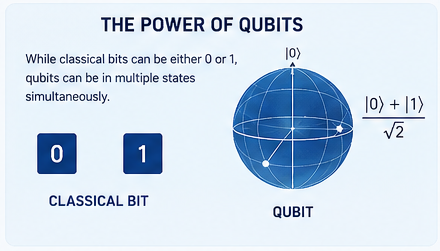
A classical bit can only exist in one state at a time:
- 0
- 1
A qubit, however, can exist in multiple states simultaneously because of a quantum phenomenon known as superposition.
This unique characteristic allows quantum computers to evaluate numerous possible solutions at the same time, enabling them to solve specific complex problems much more efficiently than traditional computers.
It's important to understand that quantum computers are not designed to replace laptops, desktops, or smartphones. Instead, they complement classical computers by tackling computationally intensive tasks that would otherwise take years—or even centuries—to solve.
Understanding the Difference Between Classical and Quantum Computers
To appreciate the significance of quantum computing, it's helpful to compare it with traditional computing.
Classical Computers
Every digital device you use today-your smartphone, laptop, gaming console, or server—operates using classical computing. These systems process information through billions of tiny switches called transistors that represent either a 0 or a 1.
Classical computers excel at everyday tasks such as:
- Browsing the internet
- Editing documents
- Playing games
- Running business software
- Streaming videos
- Programming applications
Although modern supercomputers are incredibly powerful, they still solve problems sequentially or with limited parallel processing.
Quantum Computers
Quantum computers operate differently. Instead of relying solely on binary logic, they exploit quantum phenomena to perform calculations across multiple possibilities simultaneously.
This capability makes them exceptionally powerful for tasks such as:
- Optimization problems
- Scientific simulations
- Molecular modeling
- Cryptography
- Artificial intelligence
- Financial forecasting
Rather than replacing conventional computers, quantum systems will likely function as specialized accelerators connected to classical computing infrastructure.
How Quantum Computers Work
Quantum computing relies on several remarkable principles of quantum mechanics.
1. Qubits
The qubit is the fundamental building block of quantum computing.
Unlike classical bits, qubits can occupy multiple states simultaneously. Depending on the hardware architecture, qubits can be created using:
- Superconducting circuits
- Trapped ions
- Neutral atoms
- Photons
- Silicon spin qubits
Different research organizations pursue different hardware approaches, each offering unique advantages and engineering challenges.
2. Superposition
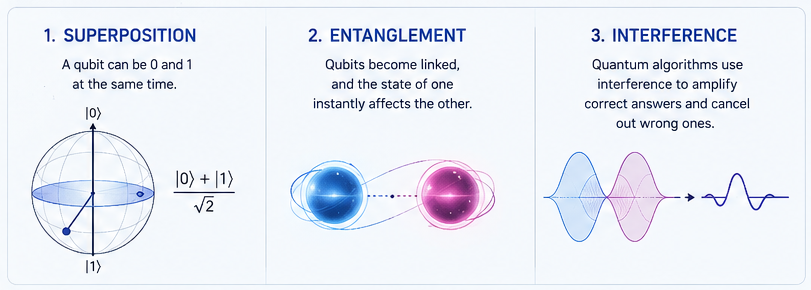
Superposition allows a qubit to represent both 0 and 1 simultaneously until measured.
Imagine a spinning coin.
While spinning, it represents neither exclusively heads nor tails.
Only when it lands do you observe one definite outcome.
Quantum systems behave in a somewhat similar way, allowing many computational possibilities to exist simultaneously during calculations.
This dramatically expands computational capability.
3. Entanglement
Entanglement is one of the most fascinating concepts in physics.
When two qubits become entangled, they remain connected regardless of physical distance.
Changing the quantum state of one instantly influences the state of the other.
Entanglement enables highly coordinated computations impossible with classical systems.
4. Quantum Interference
Quantum algorithms manipulate probability waves through constructive and destructive interference.
Correct answers become increasingly likely while incorrect possibilities cancel each other out.
This principle enables quantum algorithms to outperform classical approaches for specific computational tasks.
Why Quantum Computing Matters
Many of humanity's greatest challenges involve solving problems with enormous numbers of variables.
Examples include:
- Predicting climate change
- Discovering new medicines
- Optimizing airline schedules
- Managing global supply chains
- Simulating chemical reactions
- Breaking or protecting encryption
Classical computers often require impractical amounts of time for these calculations.
Quantum computing offers an entirely new computational framework capable of addressing these challenges.
Major Applications of Quantum Computer Technology
Healthcare and Drug Discovery
Developing new medicines requires scientists to understand molecular interactions at the atomic level.
Quantum computers can simulate complex molecules with far greater accuracy than classical computers.
Potential benefits include:
- Faster vaccine development
- Personalized medicine
- Protein folding analysis
- Cancer treatment research
- Drug interaction prediction
Pharmaceutical companies anticipate substantial reductions in research time and development costs.
Artificial Intelligence and Machine Learning
AI models continue growing larger and more computationally demanding.
Quantum computing may accelerate:
- Neural network training
- Pattern recognition
- Recommendation systems
- Natural language processing
- Computer vision
Quantum-enhanced AI could lead to smarter virtual assistants, autonomous systems, and scientific discoveries.
Cybersecurity and Cryptography
Modern internet security relies heavily on encryption algorithms.
Powerful quantum computers could eventually break certain widely used encryption methods.
However, quantum technology is also driving the development of post-quantum cryptography, designed to protect digital communications against future quantum attacks.
Governments and organizations worldwide are actively transitioning toward quantum-resistant security standards.
Financial Services
Banks manage enormous volumes of financial data requiring sophisticated analysis.
Quantum computing could improve:
- Risk assessment
- Portfolio optimization
- Fraud detection
- Market simulation
- Asset pricing
- Investment strategies
These improvements may lead to more efficient financial markets and better decision-making.
Logistics and Supply Chain Optimization
Modern supply chains involve countless variables.
Quantum algorithms may optimize:
- Delivery routes
- Vehicle scheduling
- Warehouse operations
- Inventory management
- Distribution planning
- Shipping efficiency
For global businesses, even small efficiency improvements translate into millions of dollars in annual savings.
Manufacturing
Manufacturers constantly seek better production methods.
Quantum computing could optimize:
- Factory scheduling
- Quality control
- Material design
- Equipment maintenance
- Resource allocation
These improvements can increase productivity while reducing operational costs.
Climate Science
Climate prediction requires analyzing massive environmental datasets.
Quantum computing may improve:
- Weather forecasting
- Carbon capture research
- Renewable energy optimization
- Ocean simulations
- Atmospheric modeling
These advancements could help scientists better understand climate change and develop sustainable technologies.
Material Science
Scientists use quantum simulations to design entirely new materials.
Possible innovations include:
- Better batteries
- Stronger alloys
- Advanced semiconductors
- Superconductors
- Lightweight aerospace materials
These discoveries could revolutionize transportation, energy, and electronics.
Advantages of Quantum Computer Technology
Quantum computing offers several transformative advantages.
Extraordinary Computational Speed
Certain calculations that require years on classical supercomputers could potentially be completed in hours or minutes.
Better Optimization
Many industries rely on optimization problems.
Quantum algorithms may produce more efficient solutions than traditional methods.
Improved Scientific Research
Researchers can model natural systems more accurately, accelerating discoveries across chemistry, biology, and physics.
Enhanced Artificial Intelligence
Quantum computing could significantly improve machine learning efficiency and predictive analytics.
Breakthrough Innovation
Entirely new technologies may emerge from quantum simulations that are impossible today.
Challenges Facing Quantum Computing
Despite impressive progress, quantum computing remains in its early stages.
Hardware Stability
Qubits are extremely fragile.
Small disturbances—including temperature fluctuations, vibrations, and electromagnetic interference—can introduce computational errors.
Error Correction
Quantum systems require sophisticated error-correction methods involving many physical qubits to create a reliable logical qubit.
Developing scalable error correction remains one of the field's biggest challenges.
High Cost
Quantum computers require specialized facilities, advanced cooling systems, and highly trained engineers.
Building these systems costs millions of dollars.
Limited Availability
Currently, most quantum computers are available through cloud services rather than personal ownership.
Researchers and developers access them remotely via specialized platforms.
Software Development
Quantum programming differs significantly from conventional programming.
Developers must learn entirely new algorithms, mathematical concepts, and software frameworks.
Leading Companies Investing in Quantum Computing
Many global organizations are racing to build practical quantum computers.
Major innovators include:
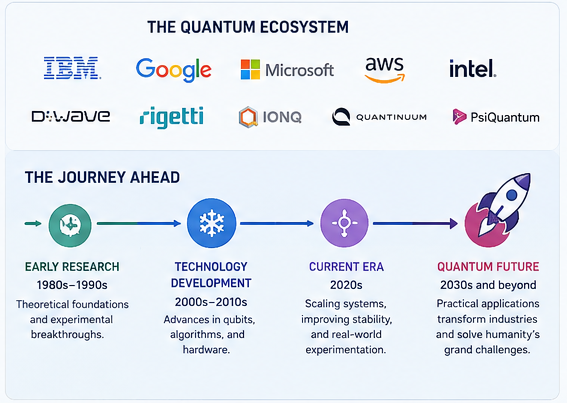
- IBM
- Microsoft
- Amazon Web Services
- Intel
- NVIDIA
- IonQ
- Rigetti Computing
- D-Wave
- Quantinuum
- PsiQuantum
- Xanadu
These companies collaborate with universities, governments, and research laboratories to advance quantum hardware and software.
Quantum Computing and Artificial Intelligence
Quantum AI is one of today's most exciting research fields.
Researchers are investigating how quantum computing can improve:
- Deep learning
- Optimization algorithms
- Data analysis
- Medical diagnosis
- Robotics
- Autonomous vehicles
Although practical quantum AI remains under development, its long-term potential is enormous.
Industries That Will Be Transformed
Quantum computing is expected to reshape numerous sectors, including:
- Healthcare
- Banking
- Insurance
- Telecommunications
- Aerospace
- Automotive
- Energy
- Manufacturing
- Defense
- Retail
- Supply Chain
- Artificial Intelligence
- Scientific Research
Organizations that invest early may gain significant competitive advantages.
How to Learn Quantum Computing
If you're interested in entering this field, start with these subjects:
- Mathematics
- Linear Algebra
- Probability
- Quantum Mechanics
- Python Programming
- Computer Science
Then explore quantum frameworks such as:
- Qiskit
- Cirq
- PennyLane
- Q#
- Ocean SDK
Many cloud platforms offer free access to beginner-friendly quantum environments, making it easier than ever to start learning.
The Future of Quantum Computer Technology
Experts believe the coming decades will witness remarkable progress in quantum computing.
Expected developments include:
- More stable quantum processors
- Millions of logical qubits
- Commercial quantum cloud services
- Quantum-enhanced AI
- Quantum internet technologies
- Revolutionary scientific discoveries
- Faster drug development
- Smarter cities
- Advanced robotics
- Sustainable energy solutions
Rather than replacing classical computers, quantum computers will likely work together with traditional systems, each handling the tasks they perform best.
Frequently Asked Questions (FAQs)
What is quantum computer technology?
Quantum computer technology is a computing approach that uses quantum mechanics and qubits to solve specific complex problems much faster than classical computers.
Are quantum computers faster than normal computers?
For certain specialized problems—such as optimization, simulation, and cryptography-yes. For everyday tasks like email, web browsing, and word processing, classical computers remain more practical.
Can quantum computers replace laptops?
No. Quantum computers are designed for specialized scientific and industrial applications, not everyday personal computing.
Why are quantum computers so powerful?
Their power comes from quantum properties such as superposition, entanglement, and interference, enabling them to process many possibilities simultaneously.
Which industries will benefit most?
Healthcare, pharmaceuticals, finance, logistics, cybersecurity, artificial intelligence, manufacturing, and scientific research are expected to see the greatest impact.
Conclusion
Quantum computer technology is poised to become one of the most transformative innovations of our time. While the technology is still evolving, its ability to solve problems that challenge even the most powerful classical supercomputers makes it a cornerstone of future scientific and industrial progress.
From accelerating drug discovery and improving artificial intelligence to optimizing global logistics and strengthening cybersecurity, the potential applications are vast. Significant engineering challenges remain, including hardware stability, error correction, and scalability, but rapid advances in research suggest that practical quantum computing will play an increasingly important role in the years ahead.
Whether you're a student, developer, business leader, or technology enthusiast, understanding quantum computing today prepares you for tomorrow's digital landscape. As research continues and real-world applications expand, quantum computing is set to redefine what humanity can achieve through computation.
No comments yet. Be the first to share a thought.